
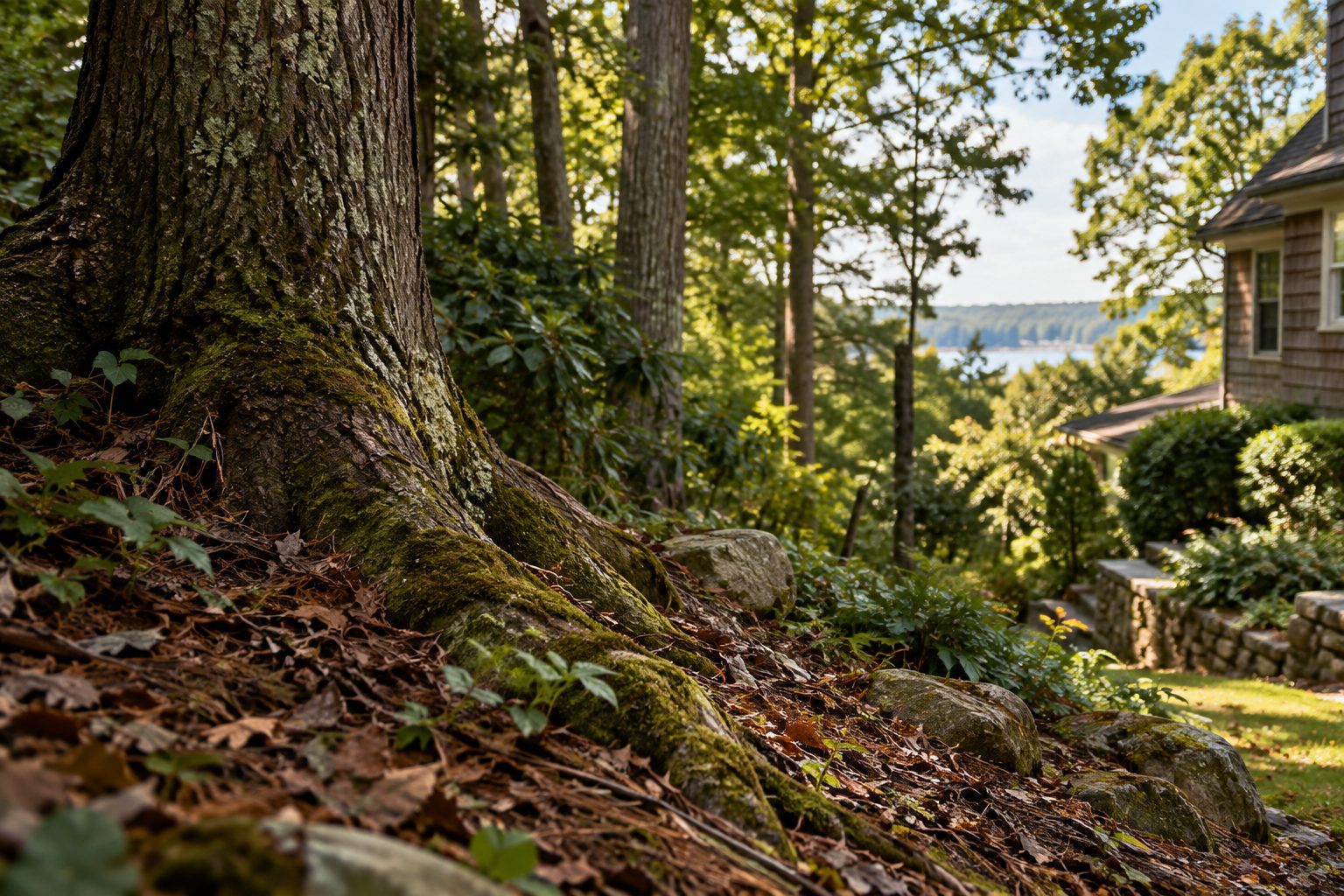
A wooded setting still has a detailed work zone
Rocky Point can put mature trees close to homes while deeper vegetation obscures the route behind them. Slopes and narrow side passages can make a tree appear more accessible from the road than it really is. Before discussing a method, walk the route and identify where the wood could be processed and loaded.
Heavy Duty Tree Service serves Rocky Point from Port Jefferson Station. Our tree removal in Suffolk County planning begins with the tree, its observed condition, and the space around it. This is a service-area guide, not a claim of a separate local office or past job at a named property.
Respect the retained canopy
Oak and pine may meet planted landscape trees on a developed lot. Mark which tree is being considered and which growth should stay. Privacy at a boundary and shade above a deck can matter as much as opening the space. A specific target avoids turning one removal into an undefined instruction across the wooded edge.
Where the concern is a branch touching a roof or blocking a path, ask about Suffolk County tree trimming. A clearance objective is different from taking out the entire tree. If decline or recent movement is the concern, describe it safely and let the site review address condition rather than relying on species or neighborhood alone.
Access has more than one dimension
A gate width is helpful, but turns, support, overhead branches, and the final working space also matter. Point out retaining edges and buried features along the proposed route. Wet ground can change suitability even when there is no obvious standing water. The estimate should explain how access affects handling and equipment.
For a tree beyond structures or a restricted landing area, evaluate crane tree removal in Suffolk County as one possible approach. Setup and reach must suit the actual site. A large tree does not automatically require a crane, and a broad frontage does not guarantee a workable lifting position.
Put the stump and debris into the same conversation
Cutting the tree near grade leaves a separate question about roots and future use. Stump grinding in Suffolk County can be listed explicitly, including footprint, material handling, and any planned return visit. It is different from excavating every root in a wooded soil area.
Specify whether branches and logs leave or stay. Retained wood needs a location and an agreed amount of processing; splitting and stacking are not automatic. Chips spread at a woodland edge are a different result from hauling and raking. Fill, grading, and landscape establishment remain separate unless the scope says otherwise.
Work dates follow conditions
Rocky Point is in the Town of Brookhaven. Requirements vary by municipality; we’ll tell you what applies. Confirm ownership and access on boundary trees and clarify responsibility for relevant approvals. Ask for current insurance documentation because the site has no verified publishable statement yet.
Published hours are 9 AM–5 PM every day, and scheduling depends on weather, workload, and the handling plan. Keep household traffic and pets away from operations. If a tree suddenly fails, maintain distance and address immediate danger or power-line involvement through the relevant services. On completion, compare the work with the identified tree, disposal choice, stump endpoint, and next-use plan so the wooded setting does not hide unresolved scope.
Questions about Rocky Point
Can privacy trees beside the target be retained?
Identify them at the estimate and discuss the access and handling around them. One removal should not leave the retained edge ambiguous.
Does a wooded lot make cleanup optional?
No. Decide which material is hauled or retained and where it goes. A wooded background is not permission to leave piles in an unspecified location.
What if the useful route is wet on the workday?
Conditions may require a changed method or date. Discuss access and ground support rather than assuming the original schedule overrides the current surface condition.